
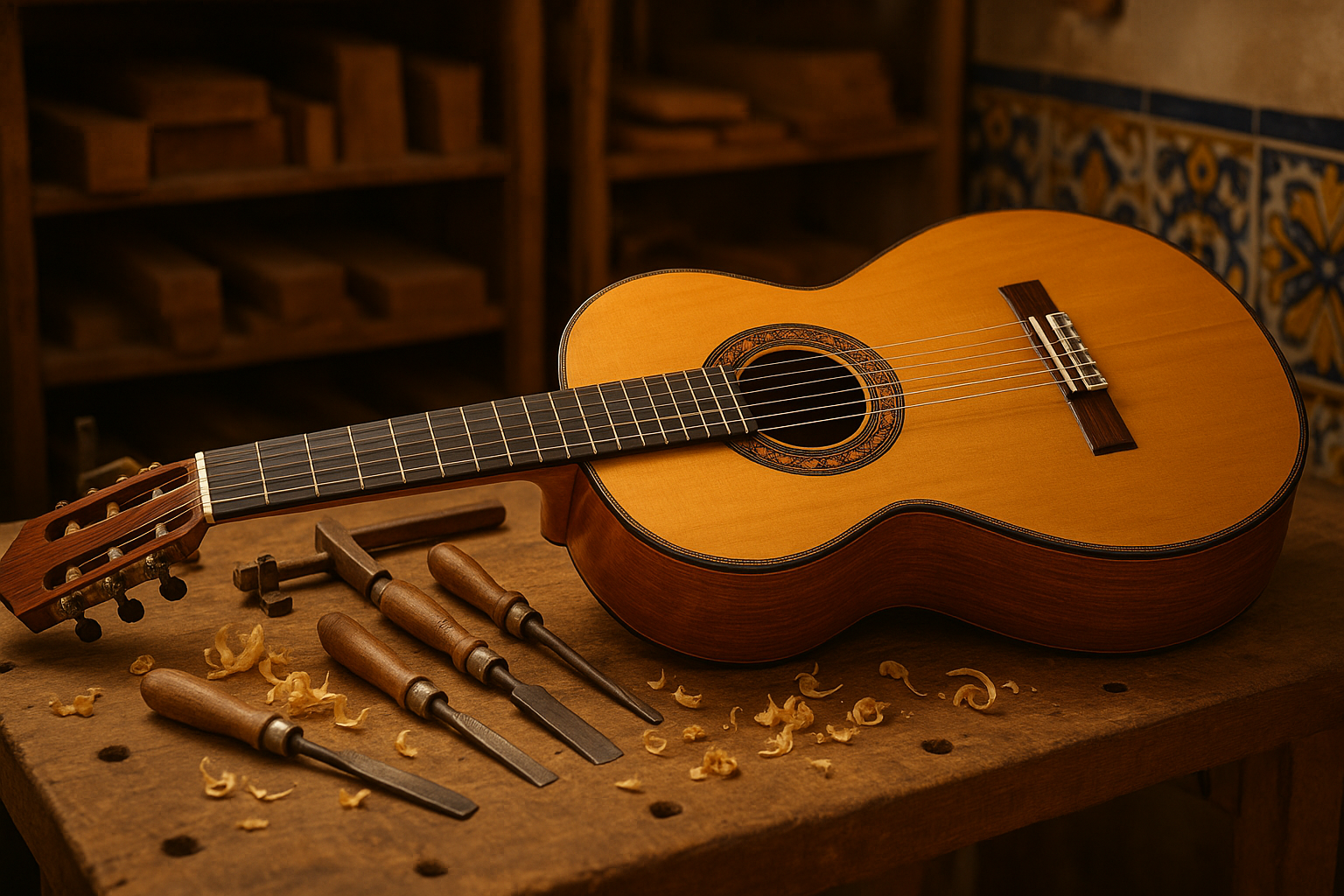
The flamenco guitar is a hallmark of Spain, deeply tied to Andalusian music and culture. Unlike its classical counterpart, it’s designed for sharp, rhythmic sounds that complement flamenco singing and dancing. Its lighter build, cypress wood construction, and unique features like the golpeador (tap plate) make it ideal for fast, percussive techniques.
Key differences between flamenco and classical guitars include:
- Sound: Flamenco guitars are bright and percussive, while classical guitars offer warm, sustained tones.
- Construction: Flamenco guitars are lighter with lower string action, enhancing speed and agility.
- Purpose: Flamenco guitars suit rhythmic, dynamic playing; classical guitars excel in solo, polyphonic music.
Whether you’re drawn to flamenco’s fiery energy or classical music’s rich depth, understanding these instruments’ roles and craftsmanship offers insights into their enduring appeal.
1. Flamenco Guitar
Origins and Cultural Influences
The flamenco guitar is a product of one of history's most profound cultural exchanges. In 18th-century Andalusia, the musical traditions of Moors, Christians, Gitanos (Spanish Roma), and Sephardic Jews intertwined, creating a distinctive musical heritage that resonated with themes of love, life, and loss. This shared legacy of marginalization gave flamenco its deeply emotional character. Over the centuries, flamenco has remained a powerful voice for the marginalized, with its lyrics often reflecting the struggles and passions of those on the fringes of society. The modern flamenco guitar became a part of this tradition around 170 years ago, during the mid-19th century, adding a new dimension to its expressive power.
Construction and Materials
Every element of the flamenco guitar's construction reflects its unique role in flamenco performances. Built for agility and clarity, it was designed to hold its own against the powerful vocals of singers and the rhythmic intensity of dancers. Unlike classical guitars, flamenco guitars are lighter, which enhances their percussive sound. Cypress wood is often used for the back and sides instead of the rosewood found in classical guitars, giving the instrument a sharper attack and shorter sustain.
The string height is another defining characteristic, typically ranging from 5 to 8 mm near the bridge, compared to the 10–13 mm found on classical guitars. Flamenco guitars are categorized into two types: "blanca", made with cypress for a brighter tone, and "negra", crafted from darker woods like rosewood for a deeper sound. The neck is designed to be more flexible, favoring a shorter sustain, while the body remains thinner with minimal internal bracing. A key feature is the golpeador, a protective plate that shields the soundboard from the percussive techniques often used in flamenco playing.
Sound and Playing Techniques
The flamenco guitar is known for its bright, percussive tone, which contrasts with the sustained and mellow sound of classical guitars. Flamenco players amplify this distinct sound by playing closer to the bridge, creating a harsher, rasping timbre. The guitar is often held almost parallel to the floor, a posture that reflects its traditional playing style.
Flamenco techniques are as unique as the instrument itself. These include golpe (percussive tapping on the body), picado (fast single-note runs), rasgueado (dynamic strumming patterns), and alzapua (complex thumb techniques). Flamenco also features a distinctive four-note tremolo pattern (p-i-a-m-i), unlike the three-note tremolo used in classical guitar playing. The frequent use of a cejilla (capo) not only facilitates key changes but also enhances the percussive quality of the guitar.
Contemporary Role
While the flamenco guitar remains deeply rooted in tradition, it has also evolved to embrace modern musical contexts. Today’s flamenco guitarists often blend classical techniques with traditional flamenco patterns, adding improvisation to create a style that bridges the old and the new. Despite these innovations, the essential elements - like the choice of woods and the golpeador - remain consistent, preserving its Andalusian soul.
The instrument's distinctive tone and rhythmic character have influenced various musical genres, extending its reach far beyond its origins. For those looking to experience the essence of Andalusian culture, What to Do in Conil offers a guide to local attractions that celebrate the region’s rich artistic traditions.
2. Classical Guitar
Origins and Cultural Influences
While flamenco guitars are known for their sharp, rhythmic flair, the classical guitar was developed for rich, sustained melodies. Its evolution traces back to instruments like the lute, vihuela, and five-course Baroque guitar, with the first six-string guitar crafted in 1779 by Gaetano Vinaccia in Naples, Italy. By the late 19th century, the modern classical guitar emerged, featuring a larger body, thinner tops for enhanced resonance, and fan-bracing systems.
Today, many performers prefer replicas of historical designs to connect with the repertoire's original sound and style. This historical lineage has shaped the classical guitar's unique structure, tailored to meet the demands of its intricate music.
Construction and Materials
Classical guitars are built to excel as solo instruments, delivering a clear, rich, and resonant sound with lasting sustain. The top is typically made of spruce or cedar, while the back and sides are crafted from woods like mahogany or rosewood. Compared to flamenco guitars, classical guitars feature deeper bodies and thicker woods, with higher string action (10–13 mm at the bridge) to avoid buzzing. Their necks are designed to withstand higher string tension, and cypress wood is deliberately avoided to maintain traditional tonal qualities.
Sound and Playing Techniques
The classical guitar is celebrated as a solo polyphonic instrument, capable of producing multiple voices simultaneously. Techniques such as rest-stroke (apoyando), free-stroke (tirando), slurs, and vibrato allow for intricate textures and dynamic expression. Players alternate between the index and middle fingers to achieve precision and clarity. The tone is influenced by factors like wood type, string material, nail shape, and the player's touch - spruce tops produce brighter, clearer tones, while cedar offers a warmer sound. The guitar's design enhances string vibration and resonance, giving it greater projection and volume compared to flamenco models.
"The guitar [is] a mini orchestra, producing a range of tonal colours." - Andrés Segovia
These techniques and tonal qualities continue to evolve, blending tradition with modern interpretations of classical music.
Contemporary Role
The classical guitar remains a prominent concert instrument, prized for its versatility. Interest in early guitars and high-quality reproductions has grown, allowing musicians to experience compositions as they were originally intended. Unlike the bright, percussive sound of flamenco guitars suited for rapid, rhythmic playing, classical guitars excel in delivering deep, sustained tones ideal for complex arrangements.
El Guitarrero - the making of a flamenco guitar (Part One)
sbb-itb-16ae2e6
Pros and Cons
To better understand the differences between flamenco and classical guitars, here’s a breakdown of their key characteristics:
| Aspect | Flamenco Guitar | Classical Guitar |
|---|---|---|
| Sound Character | Bright, percussive, lively with short resonance | Warm, rich, full with substantial sustain |
| String Action | Lower (5–8 mm at the bridge) for faster playing | Higher (10–13 mm at the bridge) to prevent buzzing |
| Body Construction | Shallower body, lighter build with thinner tops | Deeper body, with more internal bracing for resonance |
| Primary Use | Accompanying flamenco dancers and singers | Solo performances and classical repertoire |
| Projection | Loud and piercing but with limited sustain | Robust projection and sustain |
| Versatility | Specialized for flamenco styles | Suitable for a variety of music genres |
These distinctions explain why each guitar type thrives in its traditional role.
Flamenco guitars are designed for quick response and short resonance, perfectly matching the dynamic energy of flamenco dancing. Their lower string action supports rapid scales, a hallmark of flamenco music. Additionally, the golpeador - a protective plate - guards the instrument during aggressive finger-tapping techniques.
But flamenco guitars aren’t without drawbacks. Their shorter sustain limits their effectiveness for melodic passages that require notes to linger. The bright tone, ideal for flamenco, might come across as harsh in other musical contexts. Moreover, the low string action, while aiding speed, can sometimes result in string buzz, particularly outside flamenco settings.
Classical guitars, on the other hand, are celebrated for their rich tones and strong projection. They are crafted to emphasize string oscillation and depth, making them ideal for complex, polyphonic music that demands sustained notes and tonal richness.
"The classical guitar set‐up has a greater angle and the flamenco guitar has a right angle because the classical guitar is looking for more oscillation of the string, more depth and projection. While the flamenco guitar looks for the strings to be very close to the fretboard, more comfort when playing, faster scales and slurs. A more percussive sound is also sought."
– Cristina Ramírez, Guitarras Ramírez
However, classical guitars are less suited for rapid, percussive techniques. Their higher string action and deeper body can make flamenco techniques more challenging. Attempting flamenco on a classical guitar could even damage the instrument, as it lacks the golpeador.
When choosing an instrument, it’s essential to consider these design and sound differences. Beginners should align their choice with their musical goals: classical guitars are better for those drawn to sustained, rich tones, while flamenco guitars excel in fast, percussive styles. For those unsure of their preferred style, a "Negra" flamenco guitar - with slightly higher string action - offers a versatile middle ground. Flamenco guitars come in two main types: "blanca" (made with cypress wood) and "negra" (crafted from darker tonewoods). Negra guitars provide more resonance for solo performances while maintaining the distinct flamenco sound. Unlike flamenco guitars, classical guitars avoid cypress wood, instead using combinations of spruce, cedar, and rosewood for their signature tonal qualities.
Conclusion
The flamenco guitar is a symbol of Spain's identity, blending craftsmanship and tradition into a singular art form. With its lighter build, shallower body (85–95 mm compared to the standard 95–105 mm), and unique tonewoods, it produces a sound that is both bright and strikingly resonant.
This instrument does more than accompany flamenco performances - it serves as a voice for profound emotion. As acclaimed guitarist Pablo Sáinz-Villegas eloquently puts it:
"The guitar is one of the few instruments that is fully linked to a culture and a country, which is Spain".
UNESCO's designation of flamenco as an Intangible Cultural Heritage of Humanity, along with the recognition of more than 50 distinct flamenco styles (palos), highlights the enduring evolution of this tradition and its deep connection to the Andalusian spirit.
Today, this heritage thrives in Andalusia, where visitors can explore the artistry behind flamenco guitars. From Granada to Córdoba, traditional luthier workshops welcome those eager to witness the craft firsthand. Resources like What to Do in Conil guide visitors to these authentic experiences, offering a glimpse into the heart of flamenco culture.
The flamenco guitar seamlessly combines technical mastery with raw emotion, embodying the soul of Spain in every note.
FAQs
Flamenco guitars and classical guitars may look similar at first glance, but their construction and materials set them apart. Flamenco guitars are crafted to be lighter, with a thinner body and a slightly reinforced top to withstand golpes - the rhythmic taps that are a hallmark of flamenco playing. The back and sides are often made of cypress, a choice that gives the guitar its distinctive bright and sharp tone while keeping it lightweight. The string action is typically lower, making it easier for players to execute fast, intricate movements and enhancing the percussive quality of the sound.
Classical guitars, in contrast, are built with a focus on producing a rich and resonant tone. They tend to have a deeper body and use thicker woods like rosewood or mahogany for the back and sides, paired with spruce or cedar for the top. This combination creates a warmer, more rounded sound, perfect for the demands of classical music. The higher string action on classical guitars contributes to a greater dynamic range and longer sustain, allowing for more expressive performances.
The flamenco guitar has its roots firmly planted in the diverse heritage of Andalusia, shaped by the intertwining of Moorish, Roma (Gypsy), Jewish, and Christian traditions. This blend of cultures infused flamenco with its deeply emotional essence and complex rhythms, elevating the guitar to a central role in telling stories and conveying heartfelt emotions.
Through centuries of evolution, this rich cultural mix gave the flamenco guitar its unmistakable sound. Its sharp, percussive techniques and lively tones seamlessly enhance the intensity of flamenco singing and dancing. Today, it stands as a powerful emblem of Andalusia's artistic legacy and its multicultural past.
Yes, you can absolutely play classical music on a flamenco guitar. These two instruments have a lot in common, making the transition quite natural. That said, a few tweaks can help bring out the best sound and feel for classical pieces.
For example, lowering the action - the distance between the strings and the fretboard - can make playing more comfortable and precise. Swapping out the saddle to fine-tune string height is another useful adjustment, as it can make finger movements smoother and align better with classical techniques. With these minor changes, a flamenco guitar can handle classical music beautifully while still maintaining its distinctive charm.