
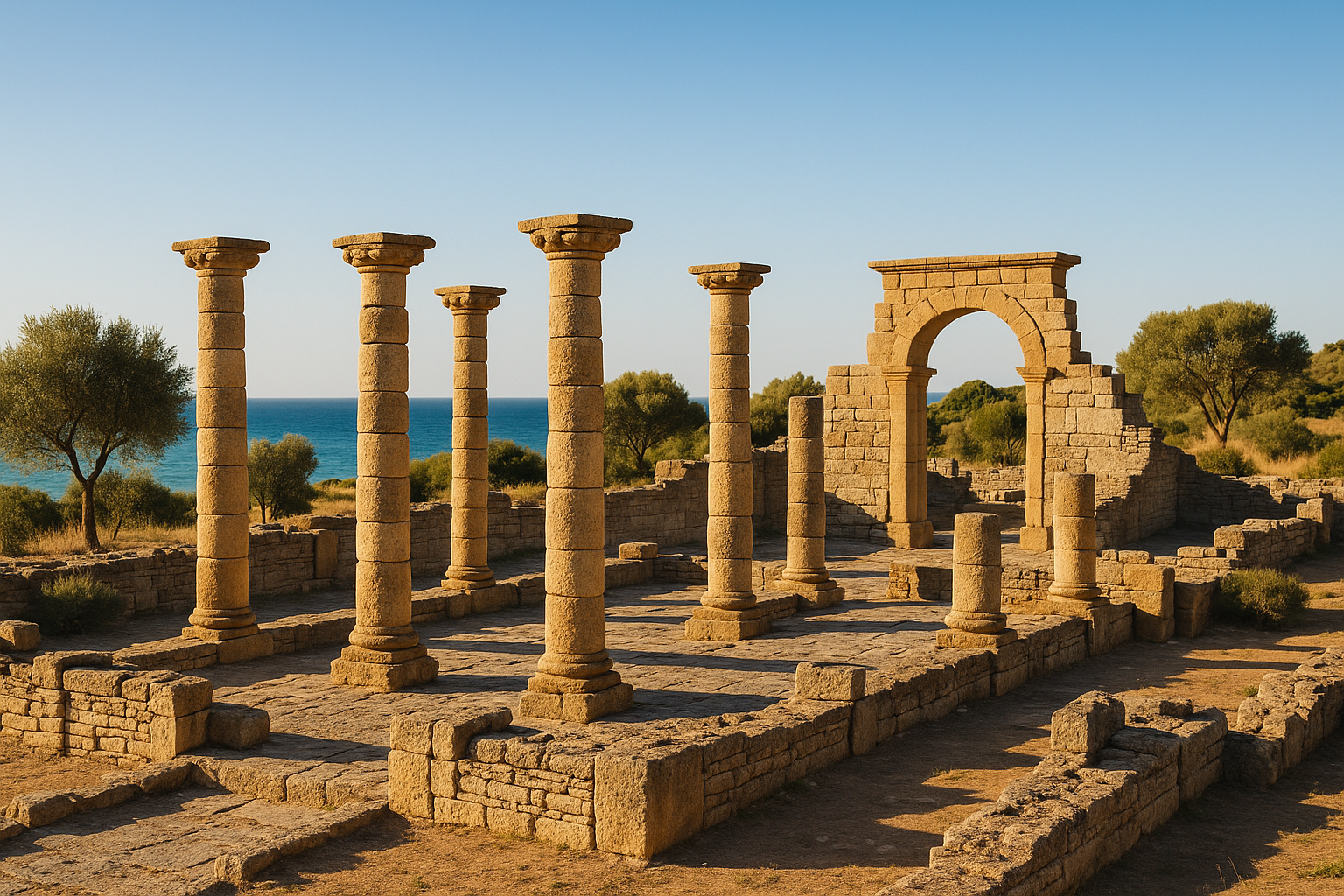
- La Huerta del Sol Necropolis: A Phoenician burial site with artifacts on display in Cádiz.
- Phoenician Settlement at El Prado: A 10th-century BC trading hub with port facilities and artisan workshops.
- Fontanilla Paleolithic Site: Prehistoric rock shelter with tools from 25,000–10,000 BC.
- Temple of Melkart on Sancti Petri Island: An 8th-century BC temple later dedicated to Hercules, accessible via boat tours.
- Baelo Claudia Roman City: A well-preserved Roman city known for garum production, temples, and a theater.
- Cueva del Tajo de las Figuras: A cave with over 500 prehistoric paintings, currently closed but viewable through exhibits.
Quick Comparison
| Site | Time Period | Features |
|---|---|---|
| La Huerta del Sol Necropolis | 1200 BC (Phoenician) | Burial site, artifacts in Cádiz Museum |
| El Prado Settlement | 10th century BC (Phoenician) | Port facilities, workshops, trade network |
| Fontanilla Site | 25,000–10,000 BC | Prehistoric tools, Solutrean artifacts |
| Temple of Melkart | 8th century BC | Submerged Phoenician-Roman temple, boat tours |
| Baelo Claudia | 2nd century BC–6th century AD | Roman city with temples, theater, baths |
| Tajo de las Figuras | Prehistoric | Prehistoric cave paintings, bird art, access restricted |
Tips for Visiting
- Best seasons: Spring (April–June) and autumn (September–November).
- Wear comfortable shoes and bring water for outdoor sites.
- Check access details and guided tour options before visiting.
These sites offer a journey through history, from ancient trade routes to prehistoric art and Roman engineering.
1. La Huerta del Sol Necropolis
Nestled in the heart of Conil de la Frontera, La Huerta del Sol Necropolis offers a fascinating glimpse into the Phoenician legacy that once shaped this coastal region. This archaeological site serves as a reminder of the rich history embedded in the area.
Historical Background
This necropolis is one of the most intriguing archaeological finds in Conil, shedding light on the Phoenician settlement that existed here centuries ago. Among the discoveries is a remarkable brass coin, now preserved in the Archaeological Museum of Cádiz, which underscores the Phoenician influence along this coastline [1]. These artifacts provide a foundation for interpreting the site's historical significance and layout.
Main Structures
While extensive excavations are yet to be carried out, the findings so far have revealed important clues about Phoenician burial customs. Researchers continue to study the site, hoping to uncover more details about its structure and the role it played in ancient times.
Visit Details
Situated in Conil de la Frontera (Cádiz), the site itself doesn’t currently offer comprehensive visitor facilities. However, artifacts from the necropolis, including the brass coin, are displayed at the Archaeological Museum of Cádiz, where visitors can explore this chapter of Phoenician history up close.
2. Phoenician Settlement at El Prado
Historical Background
The Phoenician Settlement at El Prado adds a fascinating chapter to Conil's rich archaeological story. This site highlights the extensive maritime trading network that once thrived across the Mediterranean. Situated near the mouth of the Guadarranque River, it served as a crucial hub for controlling access to Tartessian metals [4]. True to the Phoenician tradition, the settlement was strategically positioned at a river estuary, enabling efficient trade with inland regions. Its physical remains provide valuable insights into this ancient trading system.
Main Structures
Perched on Cerro del Prado, also known as Carteia la Vieja, this settlement occupied a prime elevated spot, ideal for overseeing maritime activities [5]. Archaeological findings confirm its pivotal role in the 10th-century BC trade routes dominated by Tyre [3].
Key features of the site include:
- Port facilities
- Trading warehouses
- Market structures
- Artisan workshops
Visit Details
Exploring this site becomes even more meaningful when you understand its historical importance. Here’s what you need to know before planning your visit:
Opening Hours and Access:
- Open from Wednesday to Sunday
- Hours: 10:00 to 14:00
- Closed on Mondays and Tuesdays
- Entry: Free
Getting There: Take Exit 116 from the A-7 motorway and follow the signs to Guadarranque [5]. Parking is readily available.
Guided Tours: Expert guides are available to conduct tours in Spanish, English, German, and French. Each tour lasts approximately 50 minutes, offering an in-depth look at the site's historical relevance [5].
Additional Resources: For more context, visit the Municipal Museum's Carteia exhibition, located just 5 km away on Calle San Felipe in San Roque. The exhibit showcases artifacts and provides further details about the settlement [5].
Contact Information:
- Phone: 956 90 80 30 / 600 14 30 14
- Email: cacarteia.ca.ccd@juntadeandalucia.es
3. Fontanilla Paleolithic Site
Historical Background
The Fontanilla Paleolithic Site provides a glimpse into early human activity along the Atlantic Band of Cádiz. Dating back to the Solutrean period (roughly 25,000 to 10,000 BC), this rock shelter reveals the daily lives of hunter-gatherers in southwestern Spain. It stands as a testament to their resourcefulness and adaptability during this prehistoric era [6].
The site boasts a rich collection of lithic artifacts tied to the Solutrean Superior and Solutreogravettian technocomplex. These findings shed light on the advanced hunting techniques and survival strategies employed by these early communities.
Main Structures
Initial analysis of 6,749 carved objects from the site reveals the following breakdown:
| Artifact Type | Percentage |
|---|---|
| Flakes and Blades | 53.90% |
| Debris | 18.00% |
| Waste | 14.61% |
| Cores | 4.00% |
| Retouched Products | 8.43% |
| Other (e.g., revival platelets, burin blows) | 1.04% |
Among the standout discoveries are:
- Solutrean Points: These include flat-faced points and laurel leaf-shaped tools.
- Hunting Equipment: Examples include shouldered points and backed blades.
- Processing Tools: Burins, which make up 26.71% of the identified tools [6].
These artifacts not only showcase the technological skills of the time but also offer insights into the daily lives and mobility patterns of these early inhabitants.
Visit Details
The Fontanilla site is one of 103 documented Solutrean locations in Southern Iberia [7].
Access Information:
- Situated along Cádiz's Atlantic coastline, near Conil.
- Reachable via marked trails, though accessibility can vary depending on the season.
Visiting Guidelines:
- Check with the Conil Tourism Office for up-to-date access permissions.
- Wear sturdy footwear suitable for uneven paths.
- Carry water and sun protection, especially during warmer months.
- Photography is allowed, but collecting artifacts is strictly forbidden.
"In this work, we make a summary of the settlement of «La Fontanilla» in the Atlantic Band of Cádiz... We work to define ways of life and ways of work in the huntered-gathered organized movilities in the South-West of Spain." [6] - José Ramos Muñoz, Vicente Castañeda Fernández, F. Javier Gracia
For those eager to delve deeper into the site's history, the archaeological museum in Conil offers a closer look at recovered artifacts. Exhibits include interpretative materials that provide further context [8].
4. Temple of Melkart on Sancti Petri Island
Historical Background
The Temple of Melkart, dating back to the 8th–9th century BC, was initially dedicated to the Phoenician god Melqart. Later, during Roman times, it was rededicated to Hercules Gaditanus [10][12]. According to legend, figures like Hannibal, Julius Caesar, and even Santiago the Apostle visited the temple seeking its divine blessings [9]. These layers of history add to the temple's allure and architectural fascination.
Main Structures
In December 2021, a Digital Terrain Model analysis uncovered a submerged structure measuring 300 by 150 metres at Caño de Sancti Petri [11].
Key architectural features of the temple included:
| Feature | Description |
|---|---|
| Bronze Columns | Two bronze columns, each eight cubits high [10] |
| Gateway Complex | A grand entrance flanked by large columns [10] |
| Eternal Flame | A flame that was kept burning at all times [14] |
| Decorative Art | Bronze depictions of Hercules' twelve labors [14] |
The temple also housed intriguing relics like the belt of Teucer and the tree of Pygmalion. Interestingly, human sacrifices were strictly prohibited [10].
Visit Details
To visit Sancti Petri Island, you can join organized tours departing from the Sancti Petri marina [15].
Admission Prices:
- Standard Visit: €5 (adults and children over 11), €3 (children aged 5–11)
- Guided Tour: €10 (adults and children over 11), €5 (children aged 5–11)
- Sunset Tour: €13 (adults and children over 11), €8 (children aged 5–11) – includes a refreshment [19]
Practical Information:
- Book your boat or kayak transfer in advance.
- Sunset hours offer the best lighting for photography.
- The site hosts cultural activities like astronomy workshops and live concerts [17].
- There's also an exhibition space showcasing the area's history [16].
"We researchers are very reluctant to turn archaeology into a spectacle, but in this case, we are faced with some spectacular findings. They are of great significance." – Francisco José García, director of the Department of Prehistory and Archaeology at Seville University [13]
The site enjoys a 4.0 rating on Tripadvisor, with visitors often highlighting the stunning sunset views and the temple's historical importance [18].
5. Baelo Claudia Roman City
Historical Background
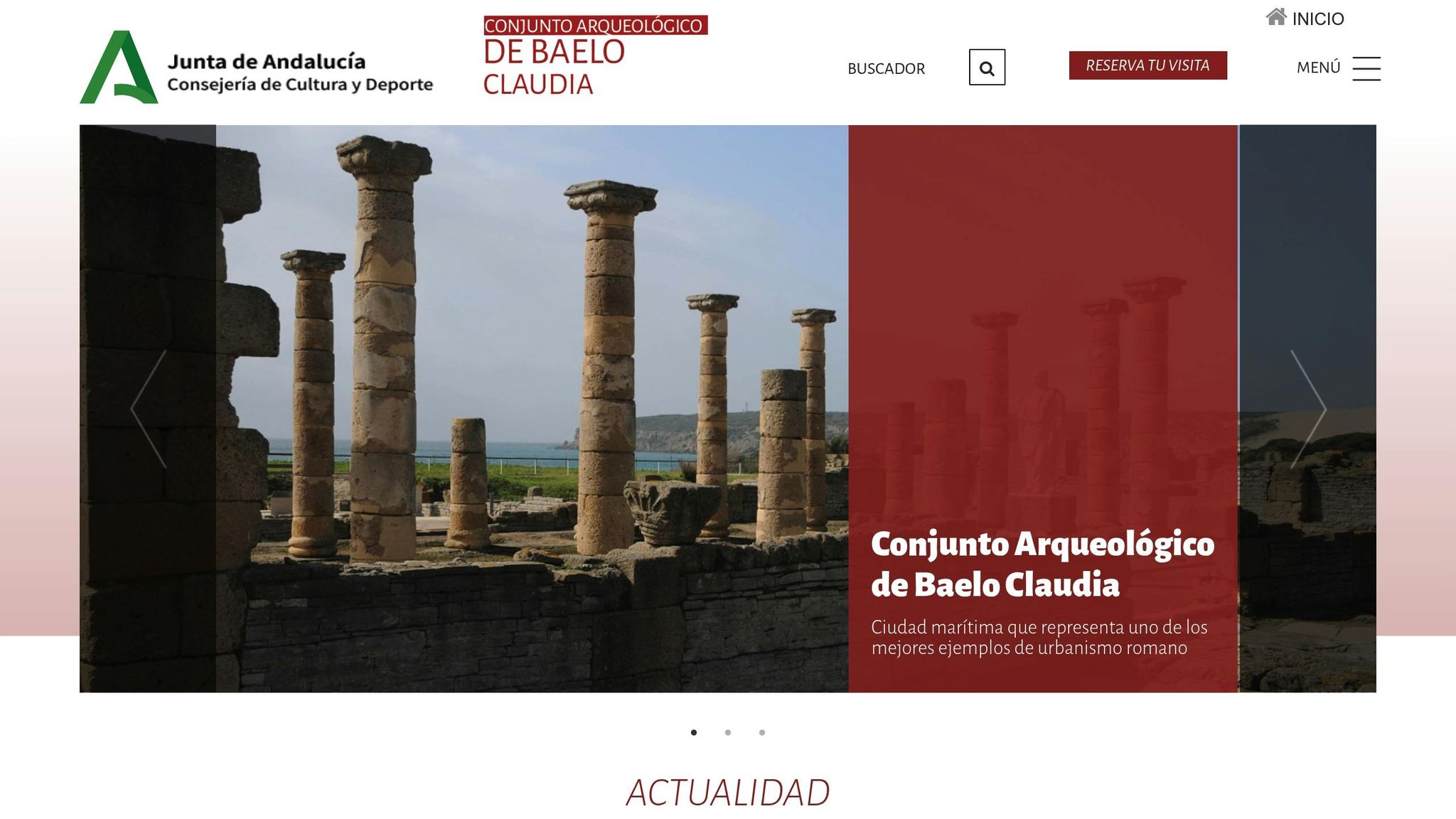
Baelo Claudia, established in the late 2nd century BC, was a bustling Roman trade center strategically located on the Strait of Gibraltar, just 14 kilometers from North Africa. During the rule of Emperor Claudius, it achieved municipium status and gained fame for its production of garum, a highly sought-after fish sauce. However, the city faced a series of setbacks, including earthquakes, pirate attacks, and economic difficulties, leading to its eventual abandonment by the 6th century AD [20].
Main Structures
Baelo Claudia stands out for its well-preserved urban layout, defined by two main streets: the decumanus maximus (running east–west) and the cardo maximus (running north–south) [20]. Visitors can explore several key structures that highlight its historical significance:
| Structure | Details | Significance |
|---|---|---|
| Basilica | 19.5 x 35.5 meters | Served as a courthouse and housed a 3-meter statue of Emperor Trajan |
| Theater | Capacity of 2,000 | A remarkably preserved venue for public entertainment |
| Forum | First-century slabs | The central square, constructed with Tarifa stone |
| Temples | Four main temples | Dedicated to Jupiter, Juno, Minerva, and Isis |
Other fascinating remains include tabernae (shops), a macellum (market), and thermae (bathhouses). These ruins offer a vivid glimpse into Roman urban life.
Visit Details
Nestled 22 kilometers from Tarifa within El Estrecho Natural Park, Baelo Claudia provides stunning views that stretch all the way to the Moroccan coastline [2] [20].
Admission Prices:
"Baelo Claudia is one of Andalucia’s most significant and well-preserved Roman archaeological sites." – Sam Pulman-Slater [2]
Practical Tips:
- Visit during spring or autumn for pleasant weather; bring sun protection and water.
- Guided tours are available by reservation [2].
- The site is wheelchair accessible [21] [24].
- Archaeological excavations are ongoing, with only 30% of the site uncovered so far [25].
Baelo Claudia enjoys a solid 4.6/5 rating on TripAdvisor, praised for its impressive ruins and informative visitor center [23]. In October 2021, it even served as a filming location for Netflix's The Crown [2].
sbb-itb-16ae2e6
6. Cueva del Tajo de las Figuras
Historical Background
Dubbed the "Altamira of schematic painting", this cave was first uncovered in 1913 by Juan Cabré and Eduardo Hernández-Pacheco. It earned recognition as an Artistic Architectonic Monument in 1924 and was later declared a national monument in 1932 [27].
The cave’s artwork spans a fascinating timeline, from the Early Holocene to the Neolithic and Copper Age, showcasing both naturalistic and schematic styles [26]. Its walls are adorned with over 500 painted figures, many of which overlap, revealing multiple phases of artistic creation and repainting [29].
Main Features
The cave is particularly renowned for its prehistoric bird paintings, which dominate its artistic repertoire. Here's a closer look at its standout features:
| Feature Type | Description | Significance |
|---|---|---|
| Bird Representations | 208 bird figures across 17 m² | Represents 99.94% of post-Paleolithic bird art found in the Iberian Peninsula [29] |
| Other Fauna | Depictions of deer and other animal forms | Offers insights into the wildlife of the ancient Laguna de la Janda [29] |
| Human Figures | Schematic human-like shapes | Thought to be linked to shamanic practices [29] |
| Signs and Symbols | Abstract motifs | Suggests a variety of cultural influences over time |
Conservation Challenges
The cave’s preservation faces several challenges, as outlined by Cañaveras et al. [28]. These include:
- Physical weathering: Damage caused by natural elements, such as frost.
- Chemical deterioration: Processes like carbo-hydrolysis affecting the sandstone.
- Biological colonization: Growth of organisms that degrade the surfaces.
- Lime deposits: A result of decades of water spraying by tour guides to improve visibility [27].
Visit Details
Since 2008, the cave has been closed to the public [30]. However, those eager to learn about its history can visit the Cádiz Prehistoric Interpretation Center in Benalup-Casas Viejas, which provides a detailed exploration of Cádiz's ancient heritage [31].
Location Information:
- Location: Near Benalup-Casas Viejas
- Coordinates: 36.3168, -5.7344
- Directions: About 400 metres uphill from kilometre 8 on the A-2226 road [30]
Access Requirements:
Researchers or special interest groups can request permission for access through:
- Junta de Andalucía
- Consejería Medio Ambiente
- Delegación de Cádiz [30]
Site Comparison
Here's a breakdown of the main highlights from Conil's top archaeological sites:
| Site Name | Time Period | Main Features |
|---|---|---|
| La Huerta del Sol Necropolis | Phoenician (c. 1200 BC) | • Ancient burial ground • Evidence of early settlement activity [1] |
| Phoenician Settlement at El Prado | 8th century BC | • Defensive walls • Necropolis • Port facilities [32] |
| Baelo Claudia Roman City | 2nd century BC – 6th century AD | • Roman temple • Forum • Basilica • Public baths • Aqueduct • Fish-salting factory [2] |
| Cueva del Tajo de las Figuras | Prehistoric | • Cave paintings • Rock art from ancient times |
This table gives you a quick overview, making it easier to pick the site that aligns with your interests.
Key Highlights
The sites reflect centuries of history, starting with the Phoenician era around 1200 BC at La Huerta del Sol Necropolis and culminating in the extensive Roman city of Baelo Claudia. These locations showcase the area's journey through time, from prehistoric rock art to advanced Roman urban planning.
Getting There
All sites are easily reachable. Most are accessible via the A-48 motorway and secondary roads from Conil. Cádiz, located just 43 kilometres away, acts as a transport hub with regular bus connections. For specific visiting hours and additional details, check with local tourist offices.
Planning Your Visit
If you're planning a trip to explore Conil's fascinating archaeological sites, consider going in spring (April–June) or autumn (September–November). During these months, you'll enjoy pleasant weather and fewer crowds, with average summer temperatures around 24°C [33].
Essential Tips
Dress for the Occasion: Choose sturdy, comfortable shoes for walking, and remember to dress modestly when visiting religious sites as a sign of respect for local customs [34][35].
Help Protect History: Keep these simple rules in mind to preserve these incredible historic locations:
- Don’t remove artifacts or stones from the sites [34].
- Stick to marked paths to minimize erosion.
- Refrain from touching or climbing on ancient structures [34].
By following these guidelines, you can help ensure these sites remain intact for future generations. Also, make sure to check for the latest visitor information before heading out.
Current Information
For the most accurate details on opening hours, ticket prices, and guided tour options, consult these resources:
- The official Conil de la Frontera Tourist Portal.
- Visitor centers at individual sites.
Weather Considerations
Plan your visit for the morning to enjoy cooler temperatures and perfect lighting for photography. If you’re adding coastal activities to your itinerary, be sure to check the wind conditions for the day.
FAQs
If you're planning to visit the Temple of Melkart on Sancti Petri Island, you'll need to hop on a boat from the marina of Sancti Petri. You’ve got options: join one of the organised boat tours for a hassle-free trip, or, if you're feeling adventurous, you can rent a kayak and paddle your way there.
For those who want to dive deeper into the site's rich past, special guided tours are available. These include boat transport and a visit to the island's castle, offering a closer look at the island's historical and cultural importance. It's a fantastic experience, especially for anyone passionate about history.
Exploring the Legacy of Cueva del Tajo de las Figuras
While Cueva del Tajo de las Figuras remains closed to visitors, there are still plenty of ways to appreciate its prehistoric artistry. Dive into its rich history through research papers, articles, and educational materials that shed light on the cave's significance and the ancient paintings it houses. Virtual tours or exhibitions often feature detailed reconstructions of the artwork, giving you a chance to admire these archaeological gems up close.
For a more hands-on approach, check with local tourism offices. They can guide you to similar sites in the region or arrange tours to related locations, allowing you to immerse yourself in the area's prehistoric heritage - all while supporting efforts to protect this remarkable site.
The La Huerta del Sol Necropolis provides a window into ancient burial traditions and everyday life, thanks to artifacts such as pottery, tools, and ceremonial objects. These finds reveal much about the history and traditions of the area. You can explore these remarkable pieces at the archaeological museum in Conil de la Frontera, where exhibits from the necropolis and other nearby sites are on display.